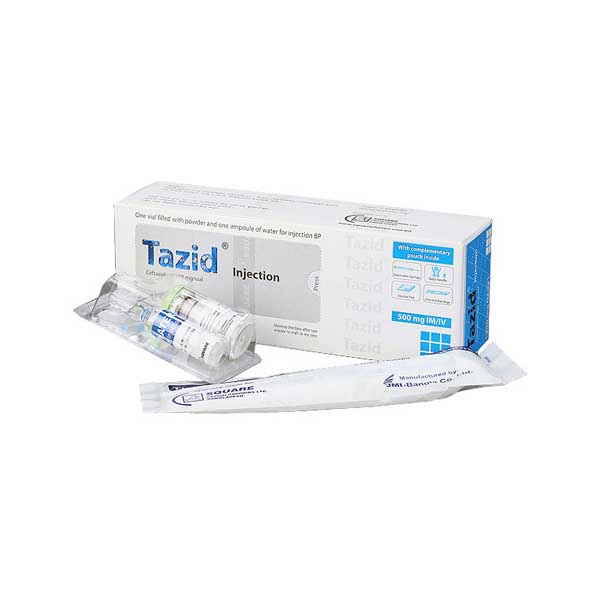
Tazid Injection is indicated for the treatment of patients with infections caused by susceptible strains of the designated organisms in the following diseases


Ceftazidime is a semisynthetic, broad-spectrum, beta-lactam antibiotic for parenteral administration. Ceftazidime is bactericidal in action exerting its effect by inhibition of enzymes responsible for cell-wall synthesis. A wide range of gram-negative organisms is susceptible to ceftazidime in vitro, including strains resistant to gentamicin and other aminoglycosides. In addition, ceftazidime has been shown to be active against gram-positive organisms.
Ceftazidime may be given intravenously or by deep IM injection into a large muscle mass such as the upper outer quadrant of the gluteus maximus or lateral proof of the thigh. Intra-arterial administration should be avoided. For IV/IM administration, Ceftazidime should be reconstituted with the supplied Sterile Water for Injection.
Ceftazidime is contraindicated in patients who have shown hypersensitivity to Ceftazidime or the cephalosporin group of antibiotics.
The most common side-effects are local reactions following IV injection and allergic and gastrointestinal reactions. Hypersensitivity reactions are pruritus, rash, and fever. Angioedema and anaphylaxis have been reported very rarely. Gastrointestinal symptoms are diarrhea, nausea, vomiting, and abdominal pain. Central nervous system reactions included headache, dizziness, and paresthesia.
The total daily dosage should be reduced when Tazid is administered to patients with renal insufficiency. Tazid should be prescribed with caution in individuals with a history of gastrointestinal disease, particularly colitis.
Tazid overdosage has occurred in patients with renal failure. Reactions have included seizure activity, encephalopathy, asterixis, neuromuscular excitability, and coma. Patients who receive an acute overdosage should be carefully observed and given supportive treatment.
Third generation Cephalosporins
Single-dose vial Administration Amount of WFI to be added: 250 mg IM in 1.5 ml, 250 mg IV in 5 ml, 500 mg IM in 1.5 ml, 500 mg IV in 5 ml and 1 g IM in 3 ml, 1 g IV in 10 ml.
Store below 25°C, protected from light and moisture. Reconstituted solutions are stable for up to 24 h if stored between 2°-8°C.