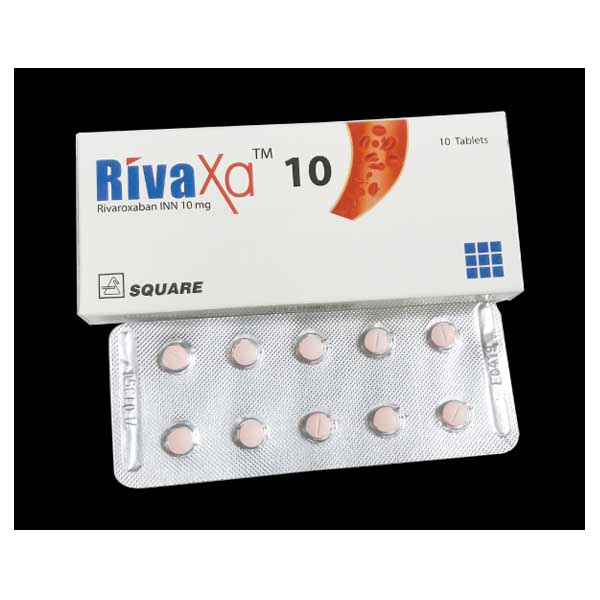
Rivaroxaban is a highly selective direct factor Xa inhibitor. Inhibition of factor Xa interrupts the intrinsic and extrinsic pathway of the blood coagulation cascade, inhibits thrombin formation.

Rivaroxaban is a highly selective direct factor Xa inhibitor. Inhibition of factor Xa interrupts the intrinsic and extrinsic pathway of the blood coagulation cascade, inhibits thrombin formation. Rivaroxaban does not inhibit thrombin (activated factor II) and no effects on platelets have been demonstrated.
Concomitant use with drugs that are combined P-gp and CYP3A4 inhibitors (ketoconazole, ritonavir, clarithromycin, erythromycin, fluconazole, diltiazem, verapamil, dronedarone) increases in RivaXa exposure and pharmacodynamic effects (i.e., factor Xa inhibition and PT prolongation), that’s why should be avoided.
It is contraindicated in patients with known hypersensitivity of Rivaroxaban or any of the excipients of the product. It is also contraindicated in patients with active pathological bleeding.
The most common side effects of RivaXa have increased chance of bleeding, spinal or epidural hematoma and increased risk of stroke after discontinuation in nonvalvular atrial fibrillation.
Rivaroxaban is a pregnancy category C drug. There are no adequate or well-controlled studies of Rivaroxaban in pregnant women, and dosing for pregnant women has not been established. It is not known if Rivaroxaban is excreted in human milk. The safety and efficacy of Rivaroxaban has not been established in breastfeeding women.
Early discontinuation of RivaXa, in the absence of adequate alternative anticoagulation increases the risk of thrombotic events.
Overdose of RivaXa may lead to hemorrhage. RivaXa systemic exposure is not further increased at single doses >50 mg due to limited absorption. A specific antidote for RivaXa is not available. The use of activated charcoal to reduce absorption in case of RivaXa overdose may be considered. Partial reversal of laboratory anticoagulation parameters may be achieved with use of plasma products.
Oral Anti-coagulants
Store in a cool (below 30°C) & dry place protected from light. Keep away from the reach of children.