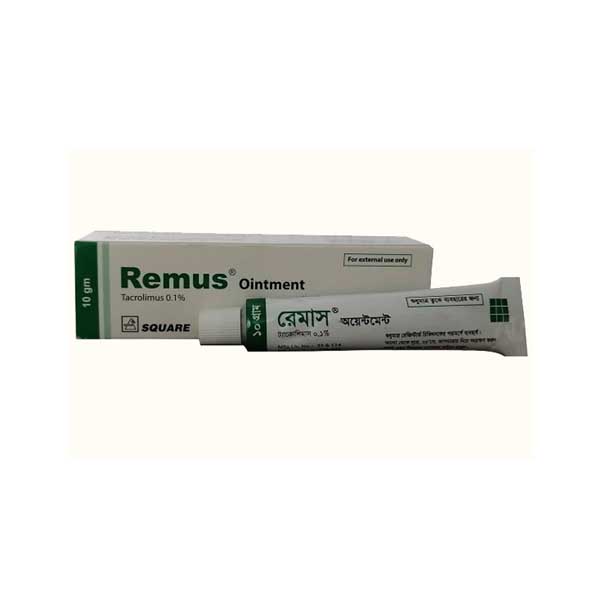
Tacrolimus is a macroiide immunomodulator produced by fungus, Streptomyces tsukubaensis.

Remus ointment is indicated for short-term and intermittent long-term therapy in the treatment of patients with moderate to severe atopic dermatitis in whom the use of alternative, conventional therapies are deemed inadvisable because of potential risks, or in the treatment of patients who are not adequately responsive to or are intolerant of alternative, conventional therapies.
Tacrolimus is a macroiide immunomodulator produced by fungus, Streptomyces tsukubaensis. It has been demonstrated that Tacrolimus inhibits T-lymphocyte activation by first binding to an intracellular protein, FKBP-12. A complex of Tacrolimus-FKBP-12, calcium, calmodulin, and calcineurin is then formed and the phosphatase activity of calcineurin is inhibited. This leads to a general decrease in the entire inflammatory cascade.
Formal topical drug interaction studies with Remus ointment have not been conducted. The concomitant administration of known CYP3A4 inhibitors in patients with widespread and/or erythrodermic disease should be done with caution. Some examples of such drugs are erythromycin, itraconazole, ketoconazole, fluconazole, calcium channel blockers and cimetidine.
Tacrolimus ointment is contraindicated in patients with a history of hypersensitivity to Tacrolimus or any other component of the preparation.
Topically applied Remus ointment have very few and rare type of side-effects including skin burning, pruritus, flu-like symptoms, allergic reactions, skin erythema, skin infections, headache, etc.
Pregnancy Category C. There are no adequate and well-controlled studies of topically administered Tacrolimus in pregnant women. Although systemic absorption of Tacrolimus following topical applications of Tacrolimus ointment is minimal relative to systemic administration, it is known that Tacrolimus is excreted in human milk. Because of the potential for serious adverse reactions in nursing infants from Tacrolimus, a decision should be made whether to discontinue nursing or to discontinue the drug, taking into account the importance of the drug to the mother.
Cautions should be exercised while treatment with Remus ointment in patients with atopic dermatitis predisposed to superficial skin infections. The safety of Remus ointment has not been established in patients with generalized erythroderma.
Remus ointment is not for oral use. Accidental oral ingestion of Remus ointment may lead to adverse effects associated with systemic administration of Remus. If oral ingestion occurs, medical advice should be sought.
Drugs affecting the immune response
Do not store above 30°C. Keep away from light and out of the reach of children.