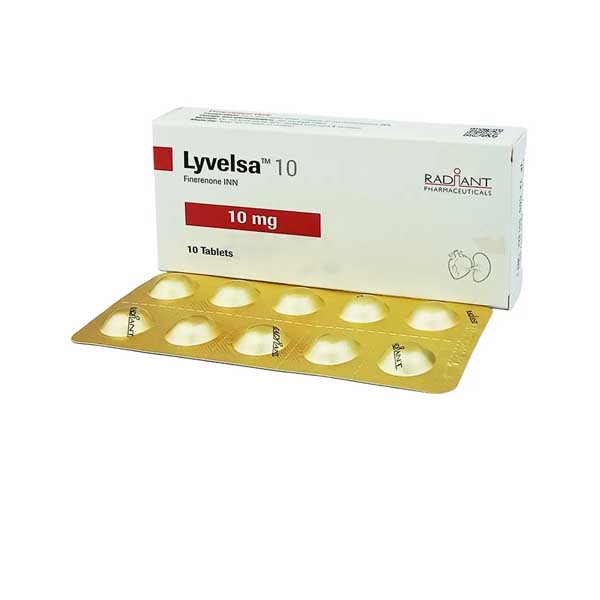
Finerenone is a nonsteroidal, selective antagonist of the mineralocorticoid receptor (MR), which is activated by aldosterone and cortisol and regulates gene transcription.
Lyvelsa tablet is indicated to reduce the risk of sustained eGFR decline, end-stage kidney disease, cardiovascular death, nonfatal myocardial infarction, and hospitalization for heart failure in adult patients with chronic kidney disease (CKD) associated with type 2 diabetes (T2D).
Finerenone is a nonsteroidal, selective antagonist of the mineralocorticoid receptor (MR), which is activated by aldosterone and cortisol and regulates gene transcription. Finerenone blocks MR mediated sodium reabsorption and MR overactivation in both epithelial (e.g., kidney) and nonepithelial (e.g., heart, and blood vessels) tissues.
Finerenone exposure increased proportionally over a dose range of 1.25 to 80 mg (0.06 to 4 times the maximum approved recommended dosage).
Absorption: Finerenone is completely absorbed after oral administration but undergoes metabolism resulting in absolute bioavailability of 44%.
Distribution: The volume of distribution at steady-state (Vss) of finerenone is 52.6 L. Plasma protein binding of finerenone is 92%, primarily to serum albumin, in vitro.
Elimination: The terminal half-life of finerenone is about 2 to 3 hours, and the systemic blood clearance is about 25 L/h.
Metabolism: Finerenone is primarily metabolized by CYP3A4 (90%) and to a lesser extent by CYP2C8 (10%) to inactive metabolites. Excretion About 80% of the administered dose is excreted in urine
Strong CYP3A4 Inhibitors: Lyvelsa is a CYP3A4 substrate. Concomitant use with a strong CYP3A4 inhibitor increases Lyvelsa exposure, which may increase the risk of Lyvelsa adverse reactions. Concomitant use of Lyvelsa with strong CYP3A4 inhibitors is contraindicated. Avoid concomitant intake of grapefruit or grapefruit juice.
Strong and Moderate CYP3A4 Inducers: Lyvelsa is a CYP3A4 substrate. Concomitant use of Lyvelsa with a strong or moderate CYP3A4 inducer decreases Lyvelsa exposure, which may reduce the efficacy of Lyvelsa. Avoid concomitant use of Lyvelsa with strong or moderate CYP3A4 inducers.
Contraindicated in concomitant use with strong CYP3A4 inhibitors & patients with adrenal insufficiency.
Adverse reactions occurring in ≥ 1% of patients on Lyvelsa and more frequently than placebo are hyperkalemia, hypotension, and hyponatremia.
There are no available data on Kerendia use in pregnancy to evaluate for a drug-associated risk of major birth defects, miscarriage or adverse maternal or fetal outcomes. Animal studies have shown developmental toxicity at exposures about 4 times those expected in humans. The clinical significance of these findings is unclear. The estimated background risk of major birth defects and miscarriage for the indicated population is unknown. All pregnancies have a background risk of birth defect, loss or other adverse outcomes.
There are no data on the presence of finerenone or its metabolite in human milk, the effects on the breastfed infant or the effects of the drug on milk production. In a pre-and postnatal developmental toxicity study in rats, increased pup mortality and lower pup weight were observed at about 4 times the AUC unbound expected in humans. These findings suggest that finerenone is present in rat milk
Lyvelsa can cause hyperkalemia. The risk for developing hyperkalemia increases with decreasing kidney function and is greater in patients with higher baseline potassium levels or other risk factors for hyperkalemia.
Pediatric Use: The safety and efficacy of Lyvelsa have not been established in patients below 18 years of age.
Hepatic Impairment: Avoid use of Lyvelsa in patients with severe hepatic impairment (Child Pugh C). No dosage adjustment is recommended in patients with mild or moderate hepatic impairment (Child Pugh A or B). Consider additional serum potassium monitoring in patients with moderate hepatic impairment (Child Pugh B)
In the event of suspected overdose, immediately interrupt Lyvelsa treatment. The most likely manifestation of overdose is hyperkalemia. If hyperkalemia develops, standard treatment should be initiated. Lyvelsa is unlikely to be efficiently removed by hemodialysis given its fraction bound to plasma proteins of about 90%.
Mineralocorticoid Receptor Antagonists
Keep below 30°C temperature, away from light & moisture. Keep out of the reach of children.